
What Is Hyper-V Replica?
Este artigo ainda não foi traduzido — está a ver a versão em inglês.
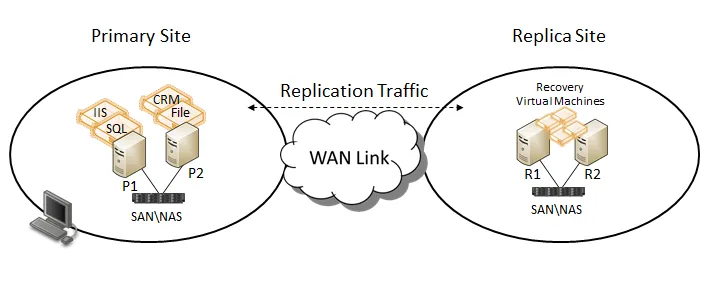
Hyper-V Replica is new functionality added to the Hyper-V Role in Windows Server 2012. Hyper-V Replica enables organizations to implement an affordable Business Continuity and Disaster Recovery (BCDR) solution for virtualized workloads. This allows virtual machines running at a primary site to be efficiently replicated to secondary location (Replica site) across a WAN link.
Purpose/Benefits
Hyper-V Replica provides a storage-agnostic and workload-agnostic solution that replicates efficiently, periodically, and asynchronously over IP-based networks, typically to a remote site. Hyper-V Replica allows a Hyper-V Administrator, in the event of a failure at a primary site (e.g. fire, natural disaster, power outage, server failure etc…), to execute a failover of production workloads to replica servers at a secondary location within minutes, thus incurring minimal downtime. The configurations at each site do not have to be the same with respect to server or storage hardware. Hyper-V Replica provides a System Administrator the option to restore virtualized workloads to a point in time depending on the Recovery History selections for the virtual machine. Hyper-V Replica provides the necessary management APIs that enable IT management vendors to build an enterprise class Disaster Recovery (DR) solution for their customers. Hyper-V Replica enables Infrastructure as a Service (IaaS) for hosting providers that host dedicated/virtual servers for their customers. With Hyper-V Replica, Hosters can provide solutions that offer DR as a service to their customers (specifically Small and Medium Business (SMB) customers).
Here is a list of terms that are relevant to the Hyper-V Replica functionality:
|
Term |
Definition |
| **Recovery Time Objective (RTO)** | The Recovery Time Objective (RTO) is the duration of time within which a business process must be restored after a disaster (or disruption) in order to avoid unacceptable consequences associated with a break in business continuity. This can also be referred to in business terms as a Service Level Agreement (SLA) |
|
Recovery Point Objective (RPO) | The Recovery Point Objective (RPO) describes the acceptable amount of data loss measured in time |
|
Application-consistent Replica | Recovery to a point-in-time that is consistent from the application’s perspective. To accomplish this, the Volume Shadow Copy Service (VSS) is used |
|
Standard Replica | A crash consistent replica of the primary virtual machine |
|
Primary server | The Hyper-V machine (Hyper-V Failover Cluster) that hosts virtualized production workloads |
|
Replica server | The Hyper-V machine (Hyper-V Failover Cluster) that hosts the replica virtual machines for a Primary server |
|
Planned Failover |
A Planned Failover is a controlled event where an Administrator gracefully moves a virtual machine from a Primary site to a replica site |
|
Failover |
A Failover is an unplanned event where the Primary site experienced a problem and replica virtual machines had to be brought online at a replica site |
|
Test Failover | A process an Administrator executes on a replica virtual machine to verify it’s functionality |
Cheers,
Marcos Nogueira azurecentric.com Twitter: @mdnoga