
CodeQL 2.27.4: what to check before closing alerts
GitHub’s 4 November announcement about CodeQL 2.27.4 is worth a look if your team relies on code scanning. The changes include more precise analysis for selected queries and a correction to vulnerability metadata. GitHub says new CodeQL versions deploy automatically to code scanning on github.com. GitHub announcement.
There are two dates here: the announcement is dated 4 November; the CLI changelog dates the version to 2 November. This is an update to review in your scanning process, rather than a reason to tell the business that application vulnerabilities were fixed by this update.
The useful question is what changed in the evidence behind an alert. A smaller backlog can reflect better analysis, a reporting change, or a genuine code fix. Those outcomes deserve different explanations.
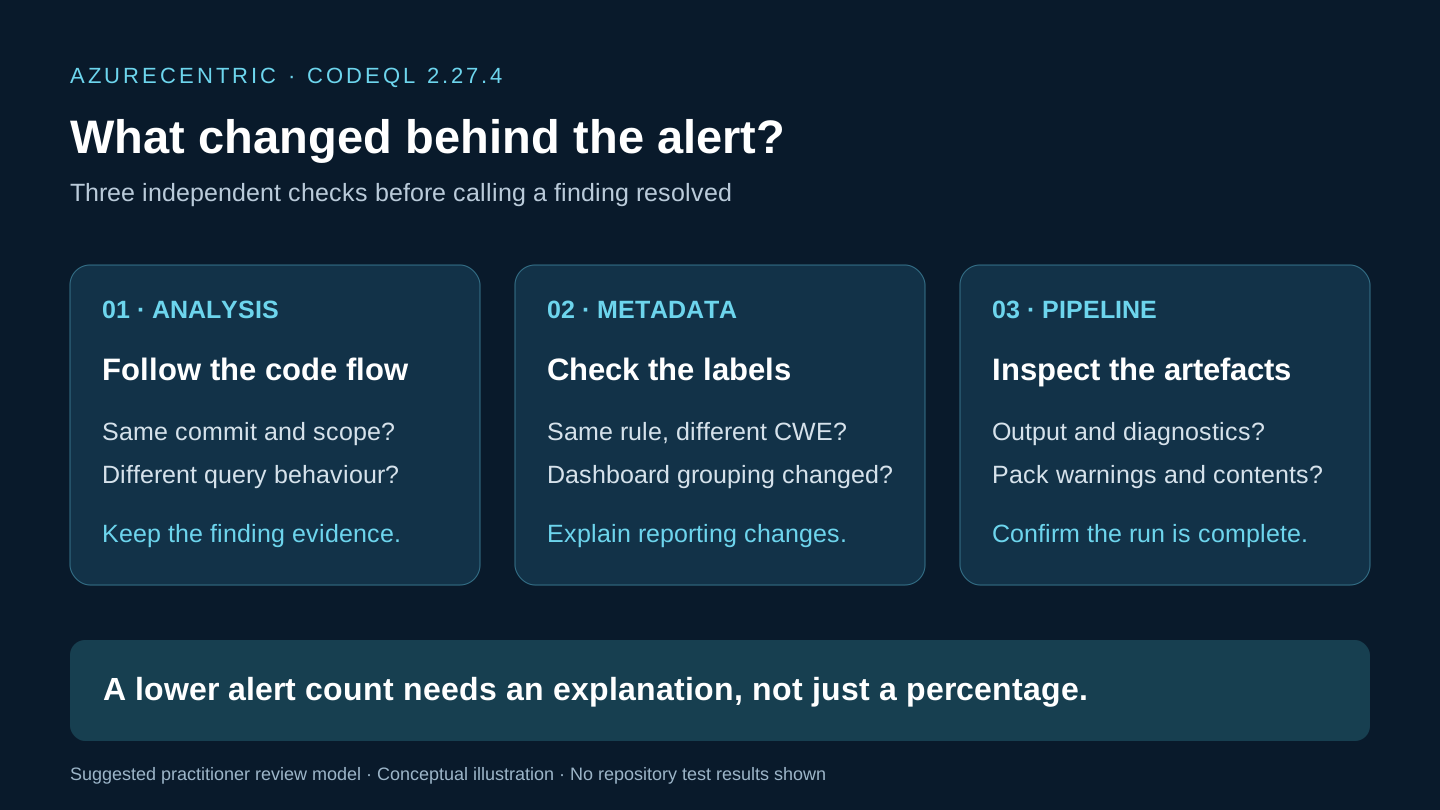
Start with the finding, then look at the count
The announcement describes additional sanitizer recognition for Java/Kotlin log-injection analysis and fewer false positives in selected Rust queries. These are targeted improvements, rather than a promise that every alert in those languages will become more accurate. Query changes.
Consider a hypothetical Java service that accepts a request value and writes it to an application log. The team already has a transformation between input and logging. After an analysis update, an alert disappears.
Before closing the remediation ticket, ask whether anyone changed the application. If the same commit was analyzed, a different result could be explained by the analyzer recognizing a pattern it previously missed. That is useful, but it is a different outcome from a developer correcting the code.
Then inspect the actual data flow. Which input reaches which log operation? What transformation sits between them? Does its behaviour address the particular risk, including the format expected by the receiving system? Recognition by an analysis rule should not become a blanket approval of every use of that library.
This is a suggested review exercise, not a result from a repository I have tested. Its purpose is to keep the explanation attached to the individual finding.
A changed CWE label needs a reporting check
The release notes remove CWE-730 from selected queries while retaining their other CWE tags. Metadata changes.
MITRE identifies CWE-730 as an OWASP Top Ten 2004 denial-of-service grouping, prohibited for mapping individual vulnerabilities. MITRE entry.
For a team maintaining a vulnerability dashboard, the practical concern is continuity. If a report groups findings only by that label, its totals could move without a corresponding application change. Check the query identifier, affected code and remaining classification before interpreting the trend.
Keep a short note with the report explaining the classification change. A stakeholder should be able to distinguish a changed label from an engineering task that removed an exposure. Otherwise, a well-intentioned reporting improvement can leave everyone discussing the wrong result at the next review.
Check the pipeline as well
Two CLI details deserve attention: JVM diagnostics move to standard error, and pack bundling or publishing excludes files whose resolved symbolic links leave the pack root, with a warning. CLI changes.
If you maintain a custom wrapper, review how it captures machine-readable output and diagnostics. Keep errors visible to the operator while allowing the consumer to parse the intended output. A successful parser is only one check; confirm that the analysis and its expected results were actually produced.
For custom query packs, inspect warnings and the resulting contents. If something expected is missing, investigate the file layout before distributing the pack. Avoid treating a warning as harmless simply because the command completed.
A small adoption review
For one representative repository, the following worksheet provides a sensible starting point. These are suggested checks, not official portal instructions.
| Observation | Evidence to keep | Decision to make |
|---|---|---|
| A finding disappears | Commit, query ID, configuration and relevant code flow | Was this a code change, an analysis change, or a scope change? |
| A reporting category shrinks | Previous and current rule metadata | Does the dashboard need an explanatory note or a grouping adjustment? |
| A wrapper behaves differently | Exit status, output and diagnostics captured separately | Can an operator still detect a failed or incomplete run? |
| A pack emits a new warning | Warning and inspected archive contents | Does the pack include what its consumers require? |
Record the CodeQL and query-pack versions actually used. Keep the commit, language coverage and query selection comparable wherever possible. If your hosted workflow does not give you a controlled before-and-after run, record that limitation rather than constructing a comparison from unrelated scans.
GitHub’s SARIF guidance explains that stable rule identifiers and file paths matter when matching results between runs. Check those inputs before calling an apparent alert replacement a new issue or a fix. SARIF support.
Availability also depends on your repository and subscription: GitHub documents code scanning for public repositories and qualifying organization-owned repositories with GitHub Code Security enabled. Repository requirements. Private-repository use requires paid licensing, measured by active committers. Check the affected repositories and contributors before expanding coverage. Licensing and billing.
Start with a review someone can explain. Keep useful analysis improvements, adjust reporting where needed, and leave each remediation decision supported by evidence from the affected code. That gives the next security meeting something more useful than a lower number.
Cheers,
Marcos Nogueira
Connect with me on LinkedIn